
Challenging Conventional Space: Reflections on Never Stand Still, a Contemporary Dance Production by ASK Dance Company

Contemporary dance rarely asks its audience to arrive at a single conclusion. More often, it invites us to observe, question, and construct our own interpretations through movement, images, and lived experience. This was precisely how I chose to approach Never Stand Still, choreographed by Zulkarnain Zuber and presented by ASK Dance Company. Before entering the performance space, I made a deliberate decision not to read the programme notes. I wanted each work to unfold on its own terms, allowing my responses to emerge from what I witnessed rather than from explanations provided beforehand. As someone who works within dance, I have always believed that choreography deserves to be encountered before it is interpreted. The production brought together four distinct works, each offering a different choreographic voice while remaining connected through a shared commitment to experimentation. Rather than searching for a continuous narrative, I found myself responding to individual moments, images, and physical encounters that gradually accumulated into a broader reflection on the possibilities of contemporary dance practice.
As someone who works within dance, I have always believed that choreography deserves to be encountered before it is interpreted.
Watching the performance in Kongsi KL (a blank canvas; quite literally an empty warehouse space without fixed seating) inevitably shaped that experience. The venue offered a more intimate setting than a conventional theatre, allowing the audience to observe subtle details of movement, breathing and performance presence from close proximity. At the same time, the audience configuration occasionally limited a complete view of certain choreographic compositions. Depending on where one was seated, some visual relationships became clearer while others remained partially concealed. These practical limitations did not reduce the artistic value of the production. Instead, they reminded me that every performance environment influences the way choreography is experienced. What ultimately stayed with me was not the arrangement of the space itself, but the performers' ability to sustain the audience's attention through movement, commitment and artistic conviction.

Part 1
The evening opened with 9,999 Steps (Almost There, But Not Quite), performed by Jackson Anak Janda and Sera Nina Sumbin. From the outset, the work established an atmosphere of physical endurance and quiet determination. The treadmill was more than a stage prop. It created continuous physical demands that required both dancers to negotiate timing, balance, and mutual trust with remarkable consistency. What impressed me most was the commitment shown by both performers. Jackson and Nina maintained an impressive level of physical focus throughout the work, allowing the choreography to unfold without unnecessary theatrical exaggeration. Their performance relied on precision rather than spectacle, demonstrating that sustained concentration can be just as compelling as virtuosic movement.
The focused lighting further reinforced this physical dialogue, directing the audience's attention towards the dancers while allowing the surrounding environment to recede into the background. Costume changes performed within the performance space also functioned effectively as transitions, marking subtle emotional shifts without interrupting the continuity of the choreography.
Nevertheless, the work prompted one question that remained with me after it ended. While the repetitive act of walking effectively conveyed persistence and resilience, I wondered whether the symbolism suggested by the title, 9,999 Steps, might be further developed through recurring movement ideas or stronger visual metaphors. The choreography already possesses a solid physical foundation. Expanding its symbolic language could strengthen the work's conceptual impact without compromising its simplicity.
Part 2
Among the four works presented that evening, Ng Yu Jun's solo lingered in my mind the longest. It was not the most physically demanding work, nor did it rely on elaborate theatrical devices. Instead, its strength lay in its simplicity and honesty. Using the familiar act of hanging laundry as its central image, the choreography transformed an everyday routine into a thoughtful reflection on domestic life. Repetitive actions such as lifting, folding, and hanging clothes gradually developed into a movement language that carried emotional weight without becoming overly descriptive. Rather than illustrating a story, the work invited the audience to observe how ordinary actions could reveal layers of human experience.

Ng delivered the solo with admirable restraint. She avoided excessive emotional display and trusted the choreography to communicate through clarity of movement and intention. Small changes in rhythm, focus and timing became significant, allowing the audience to discover meaning gradually rather than having it imposed upon them. It was a performance that demonstrated confidence in simplicity. As I watched, I found myself thinking about the cultural meanings that domestic routines often carry within Malay society. An act as ordinary as hanging clothes is not merely a household task. It is surrounded by customs, beliefs, and social expectations passed down through generations. Although these cultural references were never stated directly, the choreography naturally opened a space for such reflections.
This was perhaps the only point where I wished the work had ventured a little further. The movement material already provided a strong foundation, yet I felt there was a missed opportunity to deepen its symbolic cultural dimension, specifically the Malay domestic culture in the region. Certain gestures or recurring choreographic motifs might have reinforced the symbolic significance of domestic labour in a Malay household, not by explaining it, but by allowing the audience to independently relate to the additional layers of meaning. Such an approach could enrich the work without sacrificing its openness or subtlety.
Part 3
If Ng's solo encouraged quiet contemplation, The Vaults of Gold shifted the atmosphere in a different direction. The work unfolded with a measured pace, allowing narrative, theatricality and movement to coexist without one dominating the other. Rather than relying on constant physical intensity, the choreography created interest through contrast, timing and carefully controlled transitions. Jackson and Ng approached the work with assurance, allowing moments of stillness to carry as much significance as movement itself. Their performances demonstrated maturity, particularly in the way they sustained dramatic tension without resorting to unnecessary physical complexity. The theatrical elements complemented the choreography, offering the audience enough space to interpret the work from their own perspectives.

One of the more unexpected moments came through the inclusion of a projected conversation with ChatGPT in this section of the production. The appearance of digital text introduced a contemporary layer to the performance and briefly shifted the audience's attention from the dancers to the screen. While the idea was intriguing, I felt the relationship between the projected dialogue and the choreography could be developed further. The technological element possessed strong conceptual potential, yet it remained somewhat disconnected from the physical world established by the performers. Even so, The Vaults of Gold demonstrated a willingness to explore new possibilities without becoming dependent on technology. The choreography remained the central focus, while the digital intervention functioned as an additional layer of interpretation. With further refinement, I believe this relationship between movement and technology could become one of the work's most distinctive strengths.
Part 4
Interchange was a notable highlight of the evening, a work that has become closely associated with ASK Dance Company and has previously received international recognition at the Yokohama Dance Collection in Japan. Watching the piece again reminded me that the longevity of a choreography depends not only on its structure, but also on the performers who continue to carry it forward.
Unlike music or literature, dance cannot be preserved exactly as it was first created. Every revival introduces physical, interpretative, and experiential novelties.
Unlike music or literature, dance cannot be preserved exactly as it was first created. Every revival introduces physical, interpretative, and experiential novelties. While original cast members often possess a deeper familiarity with the creative process, a successful choreography should also be capable of evolving without losing its artistic identity.
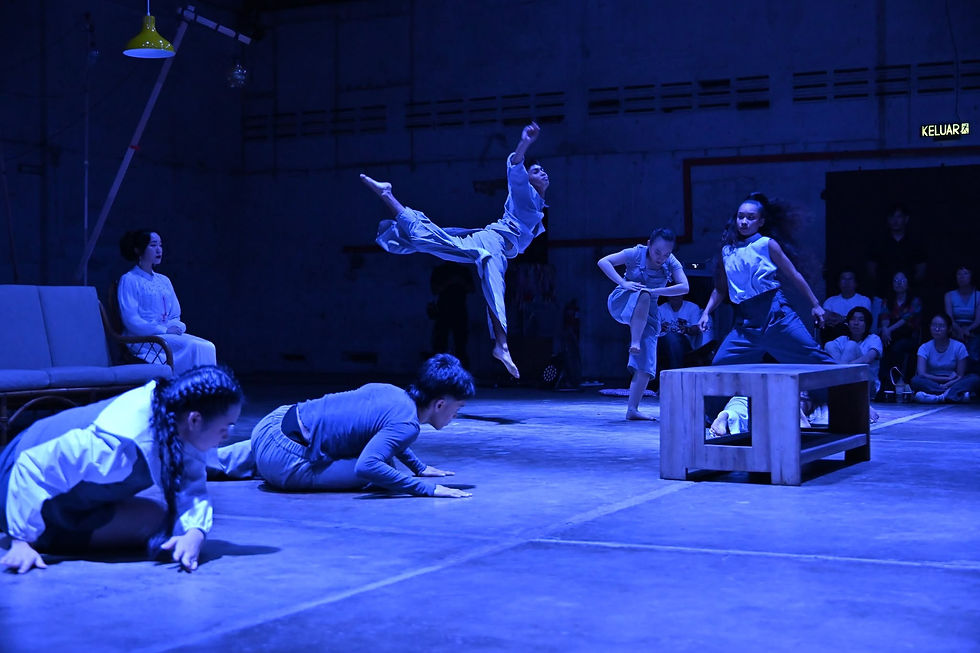
This was evident in Interchange. The current cast did not attempt to imitate those who had performed the work previously. Instead, they brought their own physical qualities and stage presence into the choreography while remaining respectful of its original structure. That balance between continuity and renewal is perhaps one of the reasons why the work continues to resonate with different audiences. Throughout the production, several performers left a particularly strong impression. Seraphic Wong and Nadhirah Rahmat consistently demonstrated confidence, clarity and control. Their performances never relied on unnecessary display. Instead, they communicated through precision, intention and an assured understanding of timing. In a performance environment where the audience was seated in close proximity, even the smallest details of expression became visible. Their ability to sustain focus throughout each work contributed significantly to the overall quality of the evening.
The participation of dance students from Universiti Pendidikan Sultan Idris (UPSI) and Taylor's University was equally encouraging. Performing alongside experienced members of ASK Dance Company can be demanding, yet the younger dancers integrated seamlessly into the ensemble. They maintained consistent energy and performance quality while adapting confidently to the different choreographic styles presented throughout the production. More importantly, their presence reflected ASK Dance Company's commitment to nurturing emerging artists through practice and performance. From a production perspective, the lighting design by Tan Eng Heng supported the choreography effectively without overwhelming it. Light was used with sensitivity, directing attention where necessary while allowing the performers to remain the central focus of each work.
The overall visual design was equally restrained. Rather than competing with the choreography, it complemented the performances and respected the character of the venue. One aspect that continued to occupy my thoughts, however, was the rear section of the performance space. Although it functioned adequately within the overall staging, I felt it offered further opportunities for visual development. A more considered use of that area could have strengthened the spatial composition and added another layer of visual interest to the production.
Concluding thoughts
Looking back on the evening, I realised that Never Stand Still never attempted to provide definitive answers. Instead, it invited the audience to remain curious. The production had impactful moments, though some concepts could be further developed; that is perhaps the nature of contemporary dance itself. It continues to evolve through experimentation, dialogue and the willingness to question established ways of creating and experiencing performance. What stayed with me after leaving Kongsi KL was not a single movement or image, but a renewed appreciation for artists who continue to take creative risks. Never Stand Still demonstrated that contemporary dance does not always need to be louder, faster or more complex to be meaningful. Sometimes its greatest strength lies in its ability to create space for reflection, conversation and multiple interpretations. That, to me, is the lasting achievement of this production.
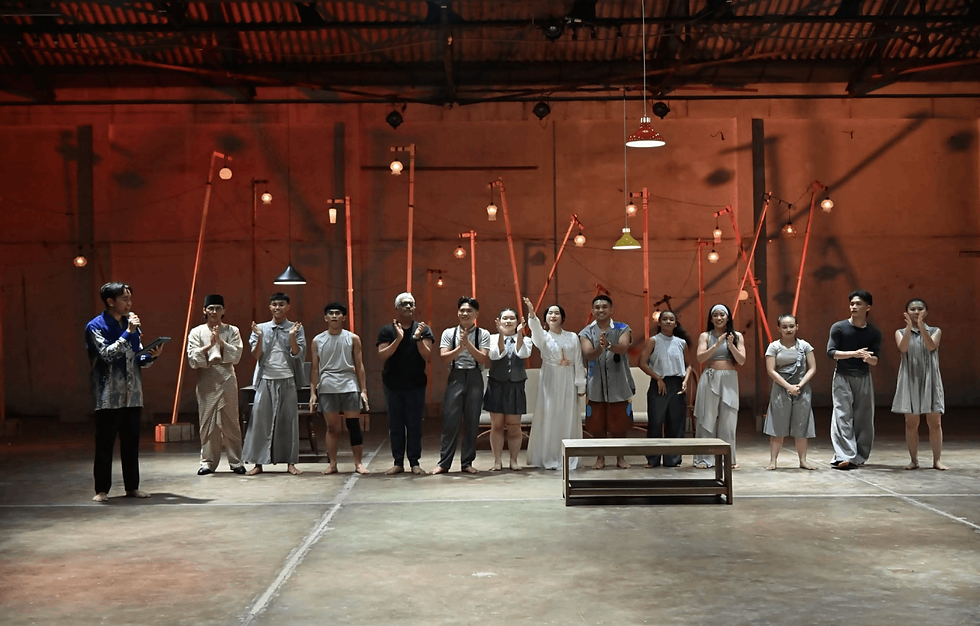

Mohd Fauzi Bin Amirudin is a Malaysian choreographer, dancer, and educator bridging tradition and contemporary innovation. A UPSI lecturer with a Master of Dance from Universiti Malaya, he has won BOH Cameronian Best Choreographer (2014 & 2026) and three WCOPA gold medals. Former principal dancer of ASK Dance Company, his work on Tari Piring continues shaping Malaysia's dance landscape.


Comments